Do you need an llms.txt file? What it does, who reads it, and how to make one
llms.txt is a proposed file that points AI tools to your key pages. See what it is, what Google says, who reads it, and how to write and test one.
On this page
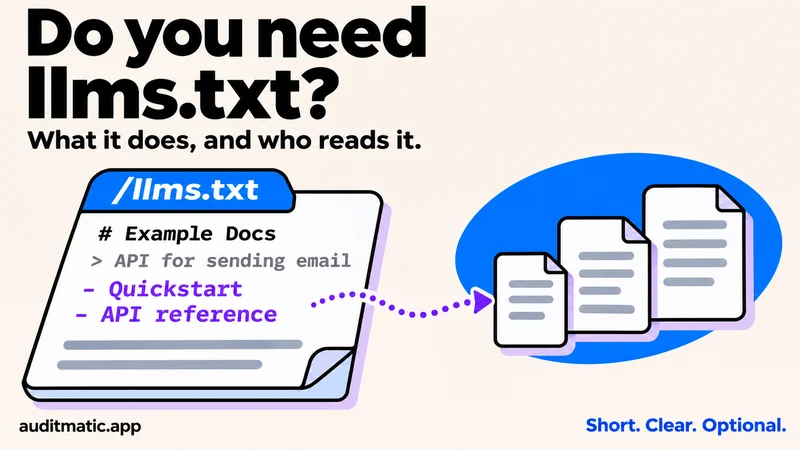
An llms.txt file is a plain text file in Markdown that sits at the root of your site and lists the pages you most want an AI tool to read. It is a proposal, not a standard, and it is not something Google needs for search. It is worth adding if you run documentation or an API that coding assistants read, and optional for everyone else. This guide explains what goes in the file, what is and is not known about who uses it, and how to check that it works.
What llms.txt is
The idea comes from Jeremy Howard of Answer.AI, who published it on 3 September 2024. The project page, llmstxt.org, calls it a proposal and describes the specification as open for community input. The purpose is simple. A language model has a limited amount of text it can read at once, and a whole website does not fit. The file gives a tool a short, curated starting point, with the detail one link away.
What goes in the file
The proposal sets out the format. In order:
- A heading with the name of your site or project. This is the only required part.
- A short summary in a blockquote.
- Optional paragraphs or lists with more background.
- One or more sections, each with a heading and a list of links. Every item is a link with a name, and can end with a colon and a note about what the page covers.
- A section titled Optional. By convention it holds secondary links a tool can skip when it needs less text.
# Example Docs

> Example is an API for sending email. These pages cover setup,
> the API reference and common errors.

## Start here

- [Quickstart](https://example.com/docs/quickstart): send your first email
- [Authentication](https://example.com/docs/auth): API keys and scopes

## Reference

- [API reference](https://example.com/docs/api): every endpoint

## Optional

- [Changelog](https://example.com/changelog): release history
The file lives at /llms.txt on the site root. It can also live in a subfolder such as /docs/llms.txt, where it covers the pages under that path. The proposal also suggests serving a clean Markdown copy of each page by adding .md to its address.
What Google says
Google's documentation on AI features in Search says there are no additional requirements to appear in AI Overviews or AI Mode, and that you do not need to create new machine-readable files, AI text files or markup to appear in them. A page needs to be indexed and eligible to show a snippet, like any other. That is the whole list. It follows that an llms.txt file will not get you into Google's AI answers.
Who actually reads it
No major AI company has committed to reading the file when it answers a question. A Google search advocate said in 2025 that he saw it as comparable to the old keywords meta tag. In June 2026 Ahrefs reported, from its own analytics sample, that most sites with the file received no requests for it. That sample leans towards technical sites, so treat it as a hint and not a measurement. The llmstxt.org page itself says it is used mostly for software documentation, which fits: the people who read it are developers who feed a docs file to a coding assistant by hand.
Should you add one?
| Your site | Add one? | Why |
|---|---|---|
| Developer docs or an API | Yes | Developers paste docs into assistants. A clear file saves them work and costs you an afternoon at most. |
| A product site with a few pages | Optional | It is cheap, but do not expect traffic from it. |
| A site that wants more Google traffic | Not for this | Spend the time on indexing, content and links instead. See the technical SEO audit checklist. |
How to check that it works
Confirm the file is served as plain text from the root, with a 200 response:
curl -I https://example.com/llms.txt
Look for 200 and a text type such as text/plain or text/markdown. Then open the file and click each link. A link that redirects, loads a login page or returns an error defeats the point. To learn whether anything reads it, search your server logs for the path and see which user agents ask:
grep "/llms.txt" access.log | awk -F'"' '{print $6}' | sort | uniq -c | sort -rnFew or no hits is normal. The check tells you whether a tool is using the file, not whether you should have written it.
Keep the file short and current
- List ten to thirty pages, the ones you would send a new user to. A list of every page defeats the purpose.
- Write one clear note per link, in plain words, saying what the page answers.
- Update it when you add or remove major pages. A stale link in the file is worse than a missing one.
- Keep the pages themselves crawlable. The file does not override the robots.txt rules that decide which AI crawlers can fetch your pages.
Serve a Markdown copy of each page
The proposal asks for more than the list. It suggests serving a clean Markdown version of each linked page at the same address with .md added, so /docs/auth also answers at /docs/auth.md. A tool that follows a link then reads the text without the menus, scripts and cookie banners around it. To announce the copy, add a link tag to the page, or send the same information in an HTTP Link header:
<link rel="alternate" type="text/markdown" href="/docs/auth.md">
This is the part that takes real work, and it is the part to skip if you have no documentation site. A plain list of good pages is still a useful file.
Frequently asked questions
Does llms.txt help SEO?
Not for Google. Its documentation says no special files are needed to appear in its AI features, and the file is not a ranking signal.
Is llms.txt the same as robots.txt?
No. Robots.txt tells crawlers which pages they may fetch. An llms.txt file only suggests where to start reading. It blocks nothing.
Do I need llms-full.txt too?
The proposal on llmstxt.org does not describe it. It asks for Markdown copies of individual pages instead. Some sites publish a combined file anyway, which is a choice and not part of the proposal.
Will an AI agent use it when it audits my site?
An agent that reads your site through a tool can follow the file as a map, but it can read your pages and sitemap without one. See how to run an SEO audit with Claude Code for what an agent does with a live site.
Check what AI crawlers can reach
An audit shows whether your key pages load, are indexable and are open to crawlers, which matters far more than the file.